
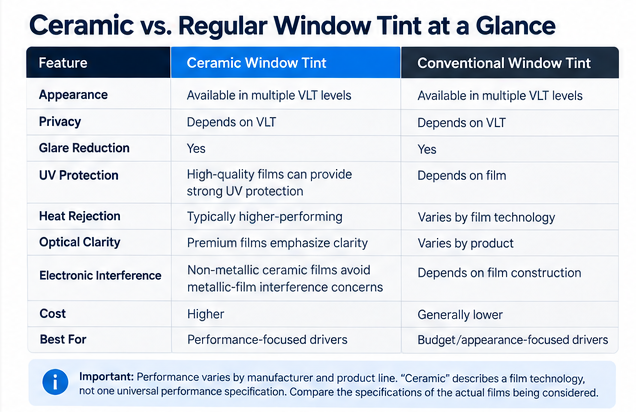
Ceramic vs. Regular Tint at a Glance
Both film types are available in multiple VLT levels, so privacy and appearance depend heavily on shade. The larger differences are generally in heat rejection, optical clarity, film construction and price.
Important: Ceramic describes a film technology, not one universal performance specification. Compare the specifications of the actual films being considered.
What Is Ceramic Window Tint?
Ceramic window tint uses ceramic-based technology rather than relying on metallic particles for its primary performance characteristics. Premium ceramic films are designed to provide strong solar-energy management while maintaining good optical clarity.
Depending on the specific product, ceramic film can offer strong heat rejection, UV protection, glare reduction, optical clarity and non-metallic construction.
What Is “Regular” Window Tint?
“Regular window tint” is a common consumer term rather than a specific technical film category. Conventional automotive films can include dyed, carbon, hybrid and other non-ceramic constructions.
A quality conventional film can still provide attractive appearance, privacy, glare reduction and UV protection. The key question is whether the added performance of ceramic film is valuable for your vehicle and driving conditions.
The Biggest Difference: Heat Rejection
Darker does not automatically mean cooler. VLT describes visible-light transmission, while solar-performance characteristics depend on film technology. A lighter premium ceramic film can provide strong heat-management performance without requiring an extremely dark appearance.
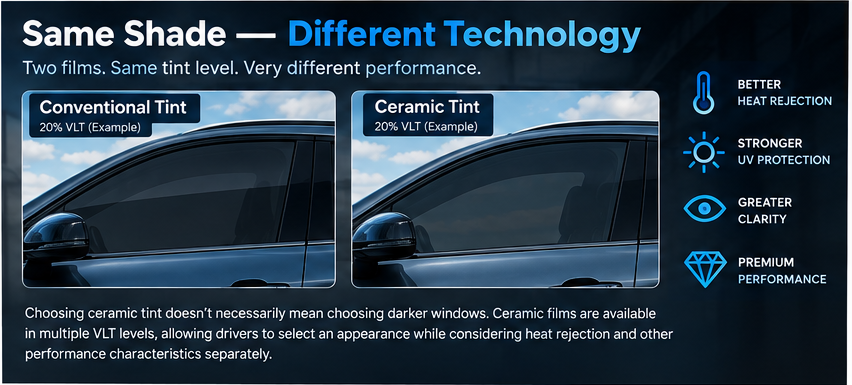
Same Shade. Different Technology.
Choosing ceramic tint does not necessarily mean choosing darker windows. Ceramic films are available in multiple VLT levels, so drivers can select an appearance while considering heat rejection and other performance characteristics separately.
For example, a conventional 20% film and a ceramic 20% film may look similar from outside while offering different heat-rejection and clarity characteristics.
How Ceramic and Conventional Tint Compare
Focus on the outcome that matters most to you.
Heat Rejection
Premium ceramic films are typically engineered for stronger solar heat rejection than basic conventional films.
UV Protection
Both quality ceramic and conventional films can provide substantial UV protection. Compare the product specifications.
Privacy
Privacy comes primarily from VLT, not from whether the film is ceramic.
Appearance
Both can look excellent. Color tone, reflectivity and optical clarity vary by product.
Electronics
Ceramic films are non-metallic and avoid the signal-interference concerns associated with metallic films.
Cost
Ceramic is generally the premium-priced option; conventional film usually has a lower initial cost.
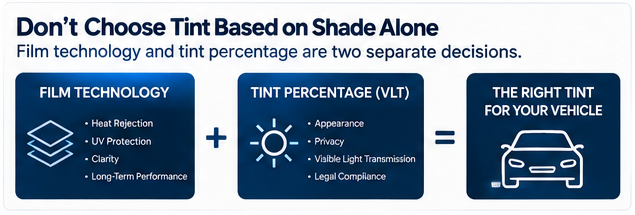
Don't Choose Tint Based on Shade Alone
Think of tint selection as two decisions:
1. Choose your film. Ceramic or another film technology determines much of the film's performance characteristics.
2. Choose your VLT. The percentage determines how much visible light passes through and strongly influences appearance and privacy.
Which Should You Choose?
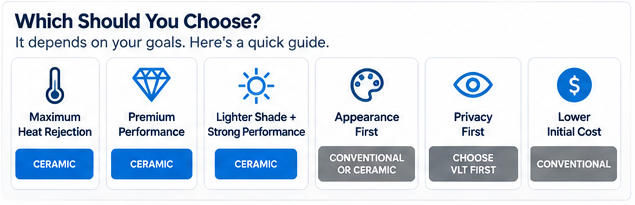
Choose ceramic when maximum heat rejection, premium performance or stronger performance at a lighter shade matters most.
Choose conventional or ceramic when appearance is the primary goal.
Choose VLT first when privacy is the primary goal.
Choose conventional when minimizing initial cost is the priority.
Ceramic Tint vs. Factory Privacy Glass
Factory privacy glass and ceramic film are not the same thing. Many SUVs, trucks and crossovers have rear glass that appears dark from the factory, but its solar-performance characteristics should not automatically be assumed to match an aftermarket ceramic film.
Can Ceramic Tint Go Over Factory-Tinted Glass?
In many appropriate applications, window film can be installed over factory privacy glass. The resulting VLT depends on the combination of the glass and film, which is why the final setup should be evaluated for both appearance and legal compliance.
Ceramic vs. Regular Window Tint FAQ
Is ceramic tint better than regular tint?
Ceramic film generally offers advantages when heat rejection and premium solar performance are priorities. Conventional films can still be appropriate when appearance, privacy or lower initial cost matters more.
Does ceramic tint keep a car cooler?
Premium ceramic films are engineered for solar-energy management and can provide stronger heat rejection than basic conventional films. Actual performance depends on the specific products being compared.
Is ceramic tint darker?
Not necessarily. Ceramic describes the film technology, while VLT describes how much visible light passes through the window. Ceramic films are available in multiple tint percentages.
Can you see through ceramic tint better at night?
Nighttime visibility is heavily influenced by VLT. A lighter film generally transmits more visible light than a darker film; ceramic technology does not eliminate the visibility effects of very dark VLT.
Does ceramic tint block UV rays?
Quality ceramic films can provide strong UV protection, but UV performance should be verified using the specifications for the specific film.
Does ceramic tint interfere with cell phones or GPS?
Ceramic films are non-metallic and are commonly chosen when avoiding potential signal-interference concerns associated with metallic film technologies.
Does ceramic tint provide more privacy?
Not simply because it is ceramic. Privacy is strongly influenced by VLT. Films with similar visible-light transmission can provide similar privacy despite using different technologies.
Is ceramic tint worth it in Michigan?
It can be for drivers who prioritize cabin comfort, solar performance and premium film characteristics. Whether the added cost is worthwhile depends on how you use the vehicle and what performance matters most.
Can ceramic tint go over factory privacy glass?
Film can be installed over compatible factory privacy glass in many applications. The resulting VLT and legal compliance depend on the combination of the glass and film.
What ceramic tint percentage should I get?
That depends on your desired appearance, privacy, visibility and applicable tint laws. Film technology and tint percentage should be considered as separate decisions.